Congratulations to Tom Parton – another image prize to add to the collection!

Tom Parton has one first prize in the Science in Innovation Unit (SIU) art in Science Oxford photo competition. Well done Tom!
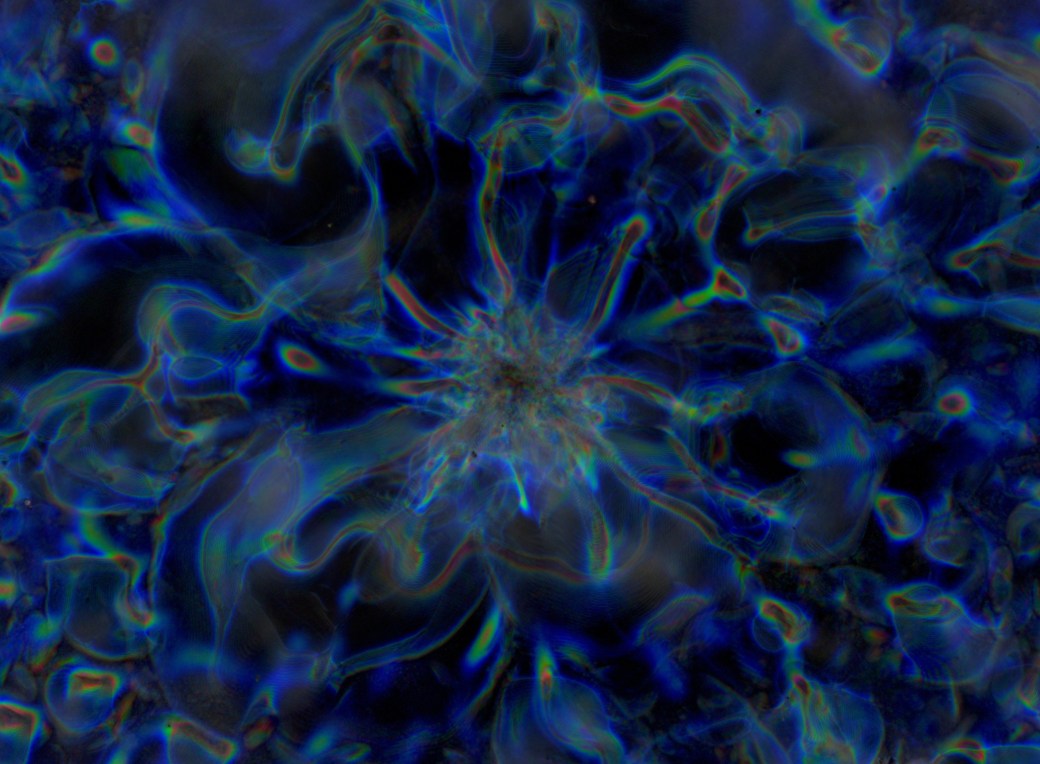
WORMKING_stitchcrop

Legend: The intense colours seen in this micrograph are created by cellulose nanocrystals, tiny slivers of carbohydrate extracted from cotton. Each individual nanocrystal is only 200 nanometres long; too small to be seen by eye, even under an optical microscope. However, under the right conditions these nanocrystals pack together into micron-scale screw-shaped structures which only reflect certain colours – in scientific terms, the colour reflected has a wavelength corresponding to the pitch (periodicity) of the screw. The image was taken on an inverted optical microscope in reflection mode with crossed polarisers.

Tom: In my research I study ways to use cellulose as a more sustainable source of colorants, instead of the dyes and plastics we currently use. The “tendrils” seen in the image are created when the cellulose crystals try to assemble around micelles (clusters of molecules called surfactants, which are the main component of soaps and detergents). I’m using these surfactants to move the cellulose crystals around and control their colour. This image is something of a failure, in scientific terms – I didn’t achieve very uniform colour – but I think it looks very beautiful nonetheless!


Tom Parton wins a prize in the CU NanoSoc Photo Competition

Congratulations to PhD student Tom Parton who has one a prize in the CU NanoSoc photo competition. Tom’s beautiful image can be seen below!
WORMKING_stitchcrop

© Thomas Parton (@ThatGladPerson)

Order and disorder. The intense colours in the photo are created by cellulose nanocrystals, which self-assembly into a chiral nematic liquid crystal structure. We believe the “tendrils” are created when the cellulose crystals assemble around azobenzene surfactant micelles in the suspension. The image was taken on an inverted optical microscopy in reflection mode with crossed polars. In my research I study the interaction of cellulose nanocrystal and azobenzene surfactants with the aim of finding ways to make colorants from more sustainable materials.

We have two PhD vacancies!

Two ERC-funded PhD studentships are available in the Photoactive Materials group at the University of Cambridge under the supervision of Dr Rachel Evans for an October 2019 start. Due to funding restriction these studentships are available to “home fees” students only.

Please see the “Opportunities” page for further information

Rachel delivers an Invited Talk at the 2nd Joint NSFC-RSC Symposium on Novel Polymer Synthesis

Rachel gave an invited talk on the group’s work on spectral converted at the 2nd Joint NSFC-RSC Symposium on Novel Polymer Synthesis to Solve Tomorrow’s Problems: Healthcare, Materials and Energy at the University of Warwick (13/14th December 2018). This meeting brings together leading UK and Chinese researchers in the field of polymer chemistry. The first meeting in this series was in Guangzhou, China in September 2016, which Rachel was also lucky enough to attend.


IMG_3215.jpg

Rachel awarded ERC Consolidator grant

Rachel and the group have been awarded a 2.1 m Euro Consolidator grant from the European Research Council. The SPECTRACON project will develop new organic-inorganic hybrid spectral converters to down- and up-convert sunlight to boost the efficiency of solar cells. PhD and PDRA vacancies will be advertised in January/February 2019, so watch this space!


New paper with collaborators in Portugal accepted in ACS Omega

Our paper with Rute Ferreira and collaborators in the Universidade de Aveiro on blue-light amplifying organic–inorganic hybrids for visible light communications has been published in ACS Omega.

Abstract Image

Flexible Optical Amplifier for Visible Light Communications Based on Organic-Inorganic Hybrids
A. Bastos, B. McKenna, M. Lima, P. André, L. D. Carlos, R. C. Evans and R. A. S. Ferreira*
ACS Omega, 2018, 3, 13772-13781.

Group members participate in RSC PPG ECM meeting

Members of the group travelled to Swansea to participate in the Early Career Members meeting of the RSC Photophysics and Photochemistry Group (http://www.rsc.org/events/detail/33561/rsc-photochemistry-group-early-career-members-meeting) (20-21st September 2018).

Elaine presented a talk on her work on In-situ UV/Vis and SANS experiments on photo switchable wormlike micelles and Morton and Benedetta presented posters on their work on luminescent solar concentrators. As Chair of the RSC PPG, Rachel had the privilege to present the RSC Marlow Award to Dr Artem Bakulin from Imperial College London. Well done all!