Welcome Joshua and Zhihang!

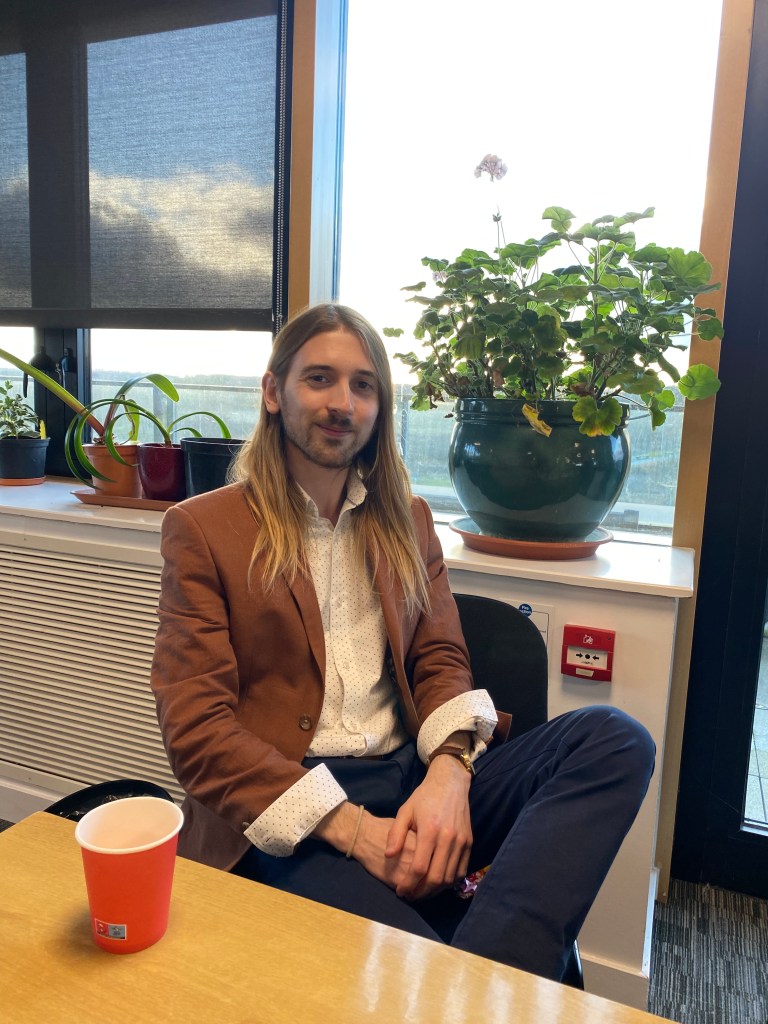
This month we welcome Dr Zhihang Wang (left) and Dr Joshua Karlsson (right) to the group as researchers on the ERC SPECTRACON project.

Zhihang joins us from Chalmers University of Technology, Sweden, where he undertook his PhD and first postdoc position working on molecular solar thermal energy storage materials under the mentorship of Prof. Kasper Moth-Poulson.

Joshua brings a wealth of experience in molecular spectroscopy, having undertaken his PhD under the supervision of Prof. Anthony Harriman at Newcastle University, followed by a postdoc with Prof. Elizabeth (Libby) Gibson on photoelectrochemical water splitting.

We are delighted to have you both join us and look forward to working with you!

Mcbain Medal symposium December 2022

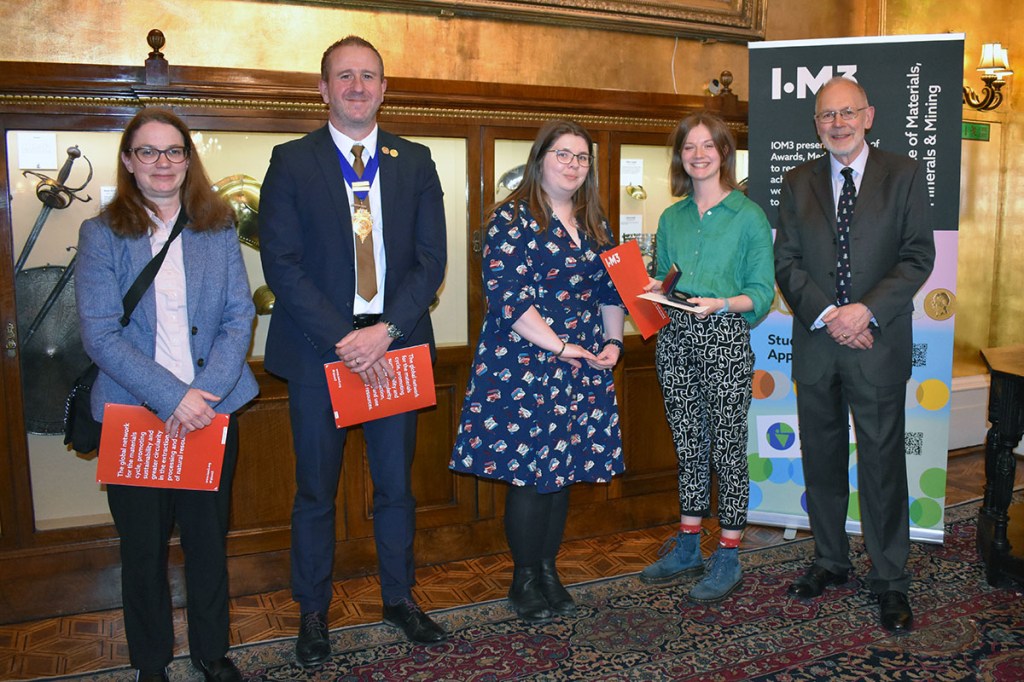
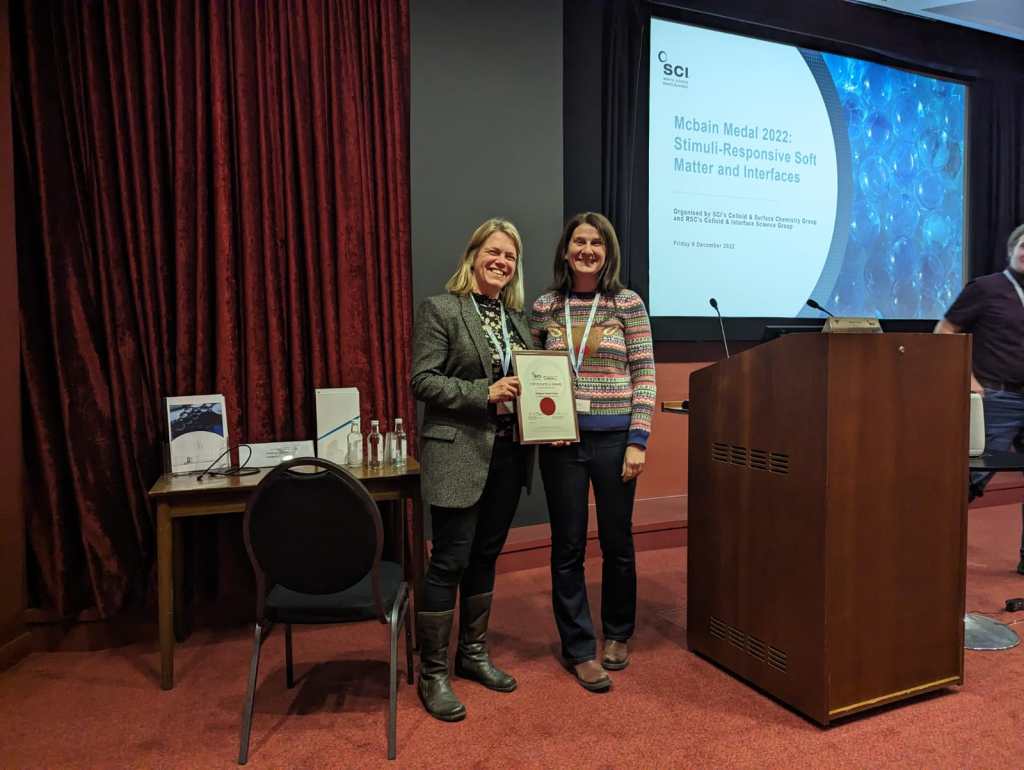
Rachel was awarded the Mcbain medal from the RSC/SCI Joint Colloid group at a dedicated symposium held in London on 9th December. The McBain Medal is presented annually to an early career researcher (within 15 years of the award of a PhD) for outstanding achievement in colloid and interface science. The symposium featured a series of fascinating talks and posters based around the theme of Stimuli-Responsive Soft Matter and Interfaces.

Congratulations also to 3rd year PhD student Bea Jones who picked up the runner-up prize for her poster presentation!

Welcome to new group members

We welcome Georgie Burgoyne-Morris, Jack Avery and Sibella Egerton to the PAM group. Georgie will be undertaking her PhD studies on triplet-triplet annihilation upconverters (TTA-UC) for solar energy conversion and contributing to the ERC SPECTRACON project. Jack, who is jointly sponsored by ISIS neutron and muon source, will be using small-angle neutron scattering to study light-responsive Pickering emulsions. Sibella joins us for her Part II project, also working on TTA-UC systems alongside Abi Collins.

Good luck to Bethan in her new role


Goodbye to Bethan who is moving on to her new role as a Lecturer in Renewable Energy at the University of Bristol. Bethan joined the PAM group in January 2020 and has spent her time characterising luminescent materials for spectral convertors and sensors. She helped manage the group’s spectroscopy lab and spearheaded our sustainability drive. In her new role she’ll be continuing the sustainability theme by researching sustainable solar materials and developing a renewable energy course.

Group presents work at ISPF2 in Milan

Final year PhD students Abi Collins and Helen Tunstall-Garcia attended and presented at their first international conference! The 3rd International Symposium on Singlet Fission and Photon Fusion: Emerging Solar Energy Technologies (ISPF2) was held in October 2022 at the Università degli Studi di Milano Bicocca.

Both Helen and Abi received a Researcher Development grant of £500 each from the Royal Society of Chemistry to fund their travel, with the remainder of funding from the European Research Council SPECTRACON grant.

Talks:

A. R. Collins (University of Cambridge, UK) Green-to-Blue Photon Upconversion for Solar Energy Harvesting using Organic-Inorganic Polymer Hosts 

H. Tunstall-Garcia (University of Cambridge, U.K) Polymer-POSS Composites as Hosts for Luminescent Solar Downshifters

New paper in JACS!

Congratulations to Bea Jones whose work on light-responsive cubosomes has been published in JACS! We created nanoparticles with an internal, cubic liquid crystal phase, suitable to entrap small molecules. Using UV light, the release of these entrapped molecules could be triggered by squeezing the cubic lattice. These stimuli-responsive release systems may have huge potential as next-generation nanodelivery devices for drugs and catalysts. This work is supported by a joint EPSRC/ Diamond Light Source studentship.

You can read the paper here: Light-Responsive Molecular Release from Cubosomes Using Swell-Squeeze Lattice Control, Beatrice E. Jones, Elaine A. Kelly, Nathan Cowieson, Giorgio Divitini, and Rachel C. Evans*, JACS, 2022.

Caption: Formation and release mechanism in light-responsive cubosomes. Azobenzene surfactants (AzoPS) are combined with a lipid, water and dye, mixed and broken up into a dispersion of particles with internal, cubic liquid crystal phases. On irradiation with UV light, the lattice contracts and squeezes out the entrapped dye particles.  

New paper in Soft Matter

Congratulations to Kieran whose work on light-responsive Pickering (particle-stabilised) emulsions has been published in Soft Matter. We identify a series of design rules to enable the preparation of light-responsive Pickering emulsions. Using a model system based on silica particles functionalised with a photoresponsive azobenzene chromophore, we demonstrated that reversible emulsification/demulsification can be achieved through the application of light.