Congratulations to 3rd year PhD student Kieran Richards, who was awarded the A&B Brief Encounters prize (jointly with Liam Ives from the Kar-Narayan group) for his 3 minute talk at the Armourer and Brasiers Forum on the 23rd June 2021. Well done Kieran!
Uncategorized
Talk prize for Bea Jones at UK Colloids 2021
Congratulations to first year PhD student Bea Jones on picking up a prize for her talk at the virtual Colloids 2021 meeting. What great achievement for your first conference talk! Bea is jointly funded by EPSRC and Diamond Light Source and will be heading to DLS in the Autumn for the next stage of her PhD on the B21 beam line.

Poster prize for Helen Tunstall-Garcia at MC15
Congratulations to members of the group who participated in the RSC’s Materials Chemistry conference, which was unfortunately held online instead of Dublin due to the C-19 pandemic.
Nell-Tunstall Garcia, Abi Collins and Bethan Charles all presented posters on their research. Huge congratulations to Nell who won a poster prize in the Materials for Energy session (see snap below) at her very first conference!
Well done to Kieran who delivered another excellent presentation with slides that are the envy of all audience members!

Congratulations to Kieran Richards for his talk tour!
Congratulations to Kieran for giving a series of well-received talks throughout June and July, including:
- IOP – Designed Assembly of Colloids at Interfaces (14th – 6th June)
- University of Cambridge (MSM) – Armourer and Brasiers Forum (23rd June)
- RSC – 15th International Conference on Materials Chemistry (12th – 15th July)
The talks covered his work on the design of light-responsive Pickering emulsions and were given to a range of audiences including industry professionals, peers in the same academic field, and specialists in the area of colloidal science.
New paper in Macromolecules!
Congratulations to Abi Collins, Michael Bennison, Bolong Zhang and Rachel Evans whose paper has been published in Macromolecules. The perspective is entitled “Organic Polymer Hosts for Triplet–Triplet Annihilation Upconversion Systems”.
The impressive artwork for the perspective featured on the front cover of the issue was made by our own Kieran Richards.
In this perspective the authors discuss the use of organic polymer hosts for triplet-triplet annihilation upconversion for solar energy and many other applications. They explore the choice of host system (which often compromises contradicting factors such as high molecular mobility, low oxygen diffusion, and high material stability) and suggest future research directions (including homopolymer blends and copolymers, organic-inorganic hybrid hosts and controlling chromophore positioning).
This work was supported by the European Research Council.

Organic Polymer Hosts for Triplet–Triplet Annihilation Upconversion Systems, Michael J. Bennison, Abigail R. Collins, Bolong Zhang, and Rachel C. Evans, Macromolecules, 2021, 54, 12, 5287–5303.
https://doi.org/10.1021/acs.macromol.1c00133
New article published in Advanced Photonics Research
Congratulations to Helen Tunstall-Garcia whose first paper co-authored with Bethan Charles and Rachel Evans has been published in Advanced Photonics Research. Their review is entitled “The Role of Polyhedral Oligomeric Silsesquioxanes in Optical Applications”.
In this review the authors examine the use of polyhedral oligomeric silsesquioxanes (POSS) for photonic applications, such as sensing, bioimaging, and optoelectronic devices. They describe the benefits of POSS (including acting as a passivating agent and preventing lumophore aggregation) and explore potential areas for future development (including in LEDs and as templating molecules for upconversion applications).
The Role of Polyhedral Oligomeric Silsesquioxanes in Optical Applications, Helen Tunstall-Garcia, Bethan L. Charles, Rachel C. Evans, Advanced Photonics Research 2021, https://doi.org/10.1002/adpr.202000196
Dr Bethan Charles’ success
We are delighted to announce that Bethan has recently been invited to become a senior member at Hughes Hall, Cambridge, where she will be taking up the role of Research Associate within the college.
Bethan is also joint winner, with Jeremie Asselin, of this year’s Armourers and Brasiers Company post-doctoral prize within the Department of Materials Science and Metallurgy. Many congratulations Bethan!
New paper in Energy & Environmental Science
New paper out in Energy and Environmental Science in collaboration with Michael Debije (Eindhoven) and Gianmarco Griffini (Milan). We make the case for treating luminescent solar concentrators (LSCs) as optical devices and outline experimental protocols for the standardisation of LSC characterisation to enable advancement of the field. Link
EPSRC New Horizons grant awarded
Rachel has been awarded an EPSRC New Horizons grant in collaboration with Kalai Saravanamuttu (McMaster University, Canada) to develop bio inspired luminescent photonic structures for indoor light harvesting. We’ll be recruiting for a PDRA post later in the year so watch this space.
Article published in Materials Chemistry Frontiers
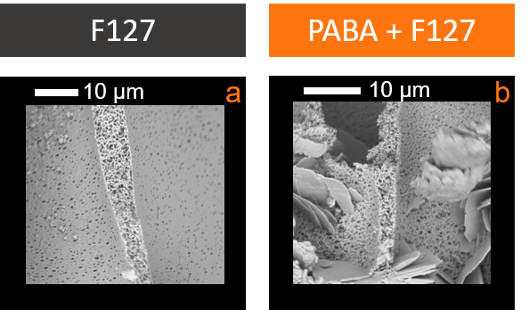
Congratulations to Tom for his paper “Dual-Template Approach to Hierarchically Porous Polymer Membranes” which has just been published as a Hot Article in Materials Chemistry Frontiers and selected for the Inside Front Cover image.
This work investigated the use of two templates as part of the manufacture of poly(ethersulfone) membranes by the non-solvent induced phase separation method. Control membranes were produced using a surfactant as the only additive, to produce a morphology with a dense skin-layer above a layer of larger finger-like vertical pores. Upon addition of a second small molecule template the microstructure at the 1 μm scale shows a distinct change from a closed structure to an open, more fibrous morphology. The effects of this microstructural change on key membrane properties are studied, with a profound increase being observed on the water permeability, which is further raised by subsequent removal of the small molecule from the product membrane.
Dual-Template Approach to Hierarchically Porous Polymer Membranes, Thomas J.F. Southern & Rachel C.Evans, Materials Chemistry Frontiers 2020, https://doi.org/10.1039/D0QM00610F

