New article in Cell Reports Physical Science

Congratulations to Morton Lyu for the co-authorship of a paper published recently in Cell Reports Physical Science. This work is a collaboration with Rute A. S. Ferreira’s group in Portugal.

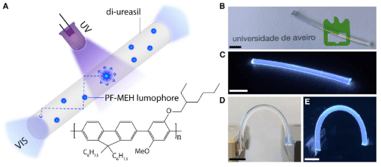
This work reports an advanced visible-light communication (VLC) system integrating an optical amplifier, made of a flexible fibre based on a poly(fluorene)-based lumophore doped within a di-ureasil organic-inorganic hybrid. VLC based on white light-emitting diodes has recently attracted much attention to provide high-bitrate data communication in indoor environments. One of the remaining challenges to be resolved to enable the proliferation of VLC systems is related to channel attenuation and multiple path fading. Our system offers a promising solution to overcome channel impairments, providing high bitrate coverage. Optical amplification is demonstrated for pre-amplifier and relay node scenarios, yielding a maximum gain of 5.9 G 0.2 dB and 3.7 G 0.2 dB, respectively, establishing the proposed approach as a promising cost-effective solution for VLCs. Additionally, numerical simulations show, for a realistic environment, a 207% improvement in the coverage area, using existing lighting infrastructure without extra cost.

Bastos, A.R., Lyu, G., Silvério, T., André, P.S., Evans, R.C., Ferreira, R.A.S.  Flexible Blue-Light Fiber Amplifiers to Improve Signal Coverage in Advanced Lighting Communication Systems. Bastos, A.R., Lyu, G., Silvério, T., André, P.S., Evans, R.C., Ferreira, R.A.S.  Flexible Blue-Light Fiber Amplifiers to Improve Signal Coverage in Advanced Lighting Communication Systems. Cell Rep. Phys. Sci. (2020), 1 (4), 100041. https://doi.org/10.1016/j.xcrp.2020.100041

New paper in Journal of Materials Chemistry B

Congratulations to former group members Ilaria Meazzini, Steve Comby and Judith Houston as well as current member Kieran Richards and visiting student François-Xavier Turquet for their work on the paper entitled “Synthesis and characterisation of biocompatible organic-inorganic core-shell nanocomposite particles based on ureasils” which has just been published in Journal of Materials Chemistry B.

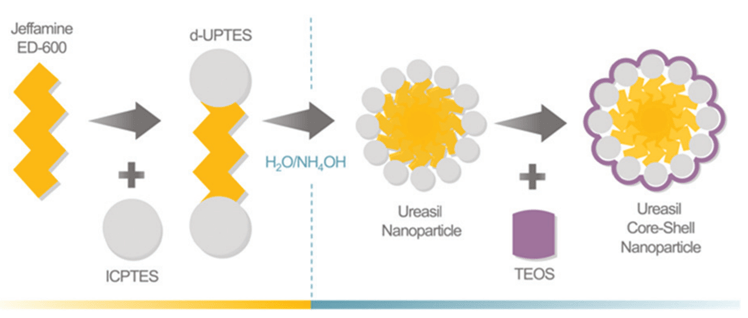
The paper reports a one-pot method for the fabrication of core-shell nanocomposite particles (CSNPs) comprising a ureasil core and a silica shell. The synthetic conditions are optimised to reproducibly form particles with a hydrodynamic diameter of ~150nm and a polydispersity of <0.2 which are stable in aqueous media for >50 days. Functionalisation of the particles via entrapment and covalent grafting is investigated using fluorescent dyes, providing insight into the internal environment of the particles.

Preliminary live/dead cell assays were also carried out, which indicate that the CSNPs do not show cytotoxicity. A huge thank you to collaborators Aimee M. Withers and Róisín M. Owens from the Department of Chemical Engineering and Biotechnology, Cambridge, for their help in obtaining these measurements.

Synthesis and characterisation of biocompatible organic–inorganic core–shell nanocomposite particles based on ureasils, I. Meazzini, S. Comby, K. D. Richards, A. M. Withers, F.-X. Turquet, J. E. Houston, R. M. Owens and R. C. Evans*, J. Mater. Chem. B.,2020, DOI:10.1039/D0TB00100G.

New Hot article in Nanoscale

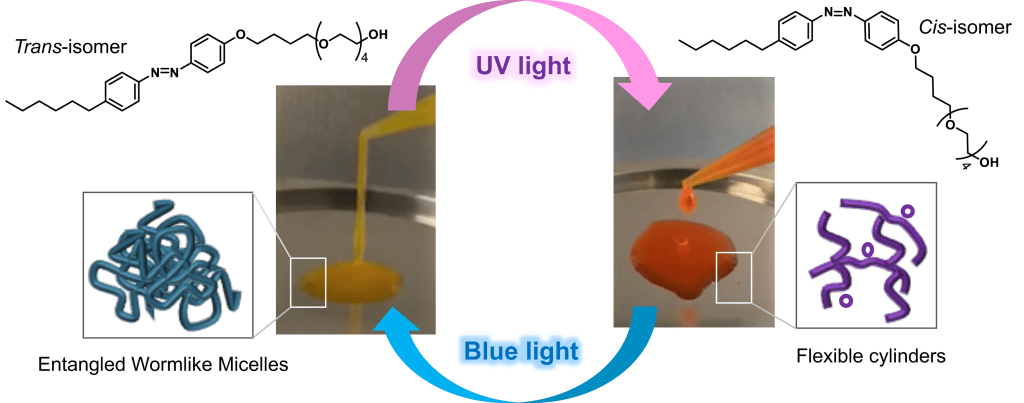
Congratulations to current and former group members Elaine Kelly, Judith Houston and Camille Blayo whose paper entitled A Single-Component Photorheological Fluid with Light-Responsive Viscosity has been published as a Hot Article in Nanoscale.

This paper reports an azobenzene photosurfactant, which at low concentrations in water, can reversibly switch between a high-viscosity, viscoelastic fluid and a watery, low-viscosity fluid, depending on the light irradiation conditions.

The work was carried out in collaboration with Nathan Cowieson at Diamond Light Source, Niamh Willis-Fox (also ex-group member) and Ronan Daly in the Institute for Manufacturing and Giorgio Divitini from the Electron Microscopy group in the department. Congratulations all!

A Single-Component Photorheological Fluid with Light-Responsive Viscosity, Elaine A. Kelly, Niamh Willis-Fox, Judith E. Houston, Camille Blayo, Giorgio Divitini, Nathan Cowieson, Ronan Daly and Rachel C. Evans, Nanoscale, 2020, 12, 6300 – 6306.

New paper for 2020 in ACS Applied Energy Materials

Congratulations to Guanpeng (Morton) Lyu for the first paper of 2020, entitled “Thermoresponsive Host Polymer Matrix for Self-Healing Luminescent Solar Concentrators”, to be accepted for publication in ACS Applied Energy Materials. The work is a collaboration with Gianmarco Griffini’s group in Milan and features the work of Benedetta, who spent part of her MSc project here in 2018 and worked with Morton.

This work reports a thin-film luminescent solar concentrator (LSC) based on a thermally reversible cross-linked host polymer, which exhibits excellent self-healing capacities. The smart cross-linked host polymer material is obtained via a dynamic-chemistry approach based on the Diels-Alder (DA) reaction between a furan-functionalised acrylic copolymer and an aliphatic bismaleimide. The cross-linked host polymer materials obtained from the DA reaction is optically clear, and capable of healing mechanical damage upon heat treatment. By carefully tuning the concentration of a perylene-based luminophore dopant, an optical efficiency as high as 4.9% can be achieved. In addition, full recovery of device efficiency is demonstrated after complete thermal healing of mechanically induced surface damages as a result of the embedded DA functionality. This work will pave the way for the development of highly efficient multifunctional thermoresponsive smart LSC systems.

Thermoresponsive Host Polymer Matrix for Self-Healing Luminescent Solar Concentrators, E. Tatsi, G. Fortunato, B. Rigatelli, G. Lyu, S. Turri, R.C. Evans*, G. Griffini*, ACS Appl. Energy Mater., 2019, DOI: 10.1021/acsaem.9b02196

Paper published in ACS Appl. Polym. Mater.

Congratulations to current and former group members Morton and James whose paper entitled “Luminescent Solar Concentrators Based on Energy Transfer from an Aggregation-Induced Emitter Conjugated Polymer” has been published in ASC Applied Polymer Materials.

This work reports a multilumophore LSC design that circumvents the problems of incomplete solar harvesting and aggregation-caused quenching through a combination of nonradiative Forster resonance energy transfer (FRET) and aggregation-induced emission (AIE): this LSC system incorporates a green-emitting polymeric AIEgen, named poly(tetraphenylethylene), as an energy donor, and a red-emitting perylene bisimide molecular dye (PDI-Sil) as the energy acceptor, within an organic-inorganic hybrid diureasil waveguide. The FRET process was shown to occur from p-O-TPE to PDI-Sil, resulting in an internal photon efficiency of 20% at optimised donor-acceptor ratio, demonstrating a viable design for LSCs ultilizing AIE-based FRET approach to improve the solar-harvesting performance.

Luminescent Solar Concentrators Based on Energy Transfer from an Aggregation-Induced Emitter Conjugated Polymer, G. Lyu, J. Kendall, I. Meazzini, E. Preis, S. Bayseç, U. Scherf, S. Clément, R. C. Evans*, ASC Appl. Polym. Mater., 2019 DOI: 10.1021/acsapm.9b00718

Applied Polymer Materials

You can read the paper here:
https://pubs.acs.org/doi/full/10.1021/acsapm.9b00718