We are delighted to announce that Kieran has been accepted onto the Brilliant Club Scholars Programme as a PhD tutor. The scheme provides university-style tutorials to school pupils from under-represented backgrounds in an effort to increase the numbers applying to highly selective universities. For more information about the scheme visit: https://thebrilliantclub.org/
Uncategorized
New paper for 2020 in ACS Applied Energy Materials
Congratulations to Guanpeng (Morton) Lyu for the first paper of 2020, entitled “Thermoresponsive Host Polymer Matrix for Self-Healing Luminescent Solar Concentrators”, to be accepted for publication in ACS Applied Energy Materials. The work is a collaboration with Gianmarco Griffini’s group in Milan and features the work of Benedetta, who spent part of her MSc project here in 2018 and worked with Morton.
This work reports a thin-film luminescent solar concentrator (LSC) based on a thermally reversible cross-linked host polymer, which exhibits excellent self-healing capacities. The smart cross-linked host polymer material is obtained via a dynamic-chemistry approach based on the Diels-Alder (DA) reaction between a furan-functionalised acrylic copolymer and an aliphatic bismaleimide. The cross-linked host polymer materials obtained from the DA reaction is optically clear, and capable of healing mechanical damage upon heat treatment. By carefully tuning the concentration of a perylene-based luminophore dopant, an optical efficiency as high as 4.9% can be achieved. In addition, full recovery of device efficiency is demonstrated after complete thermal healing of mechanically induced surface damages as a result of the embedded DA functionality. This work will pave the way for the development of highly efficient multifunctional thermoresponsive smart LSC systems.
Thermoresponsive Host Polymer Matrix for Self-Healing Luminescent Solar Concentrators, E. Tatsi, G. Fortunato, B. Rigatelli, G. Lyu, S. Turri, R.C. Evans*, G. Griffini*, ACS Appl. Energy Mater., 2019, DOI: 10.1021/acsaem.9b02196

Paper published in ACS Appl. Polym. Mater.
Congratulations to current and former group members Morton and James whose paper entitled “Luminescent Solar Concentrators Based on Energy Transfer from an Aggregation-Induced Emitter Conjugated Polymer” has been published in ASC Applied Polymer Materials.
This work reports a multilumophore LSC design that circumvents the problems of incomplete solar harvesting and aggregation-caused quenching through a combination of nonradiative Forster resonance energy transfer (FRET) and aggregation-induced emission (AIE): this LSC system incorporates a green-emitting polymeric AIEgen, named poly(tetraphenylethylene), as an energy donor, and a red-emitting perylene bisimide molecular dye (PDI-Sil) as the energy acceptor, within an organic-inorganic hybrid diureasil waveguide. The FRET process was shown to occur from p-O-TPE to PDI-Sil, resulting in an internal photon efficiency of 20% at optimised donor-acceptor ratio, demonstrating a viable design for LSCs ultilizing AIE-based FRET approach to improve the solar-harvesting performance.
Luminescent Solar Concentrators Based on Energy Transfer from an Aggregation-Induced Emitter Conjugated Polymer, G. Lyu, J. Kendall, I. Meazzini, E. Preis, S. Bayseç, U. Scherf, S. Clément, R. C. Evans*, ASC Appl. Polym. Mater., 2019 DOI: 10.1021/acsapm.9b00718
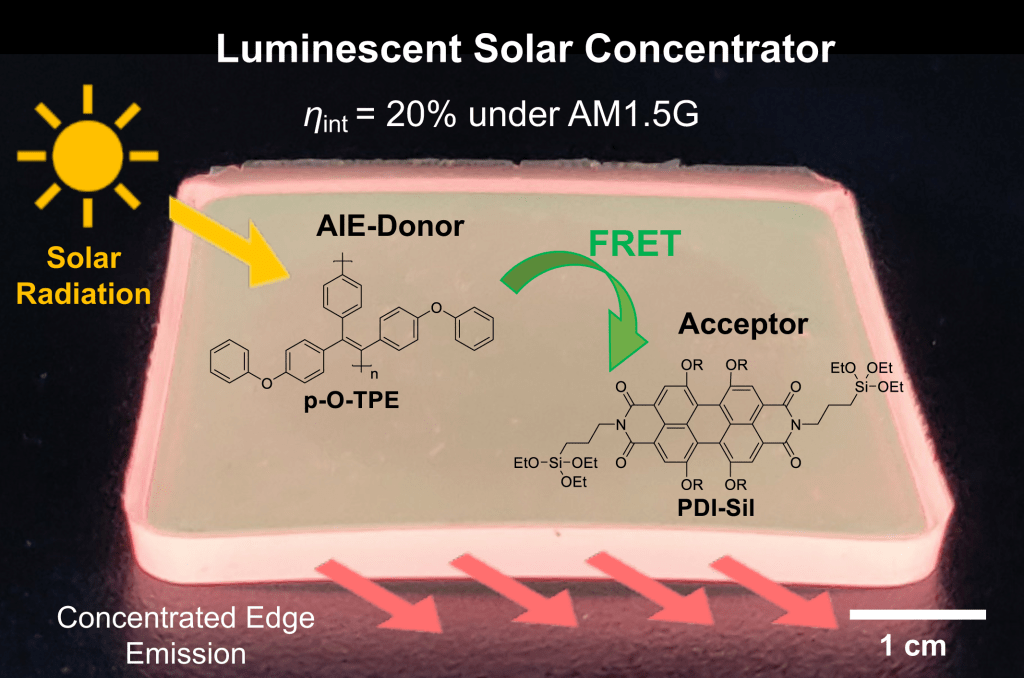
Applied Polymer Materials
You can read the paper here:
https://pubs.acs.org/doi/full/10.1021/acsapm.9b00718
Congratulations and welcome to Shomik Verma who has received a prestigious Marshall scholarship to undertake his MPhil project in the group
Shomik will be working on printed LSCs
We welcome Abigail (Abi) Collins and Helen (Nell) Tunstall-Garcia to the group
As new PhD students they will both be working on the ERC funded SPECTRACON project
Invited talk on luminescent solar devices at PAPS19
Rachel Evans gives an invited talk on the groups’ work on luminescent solar devices at the IOP Physical Aspects of Polymer Science Conference, University of Lincoln (11-13th September, 2019) http://paps19.iopconfs.org/home
Rachel Evans at RAPS19, Leeds
Rachel Evans gave a plenary talk at the Recent Appointees in Polymer Science meeting (RAPS19) at the University of Leeds (4-6th September).
New paper out in J. Mater. Chem. C.
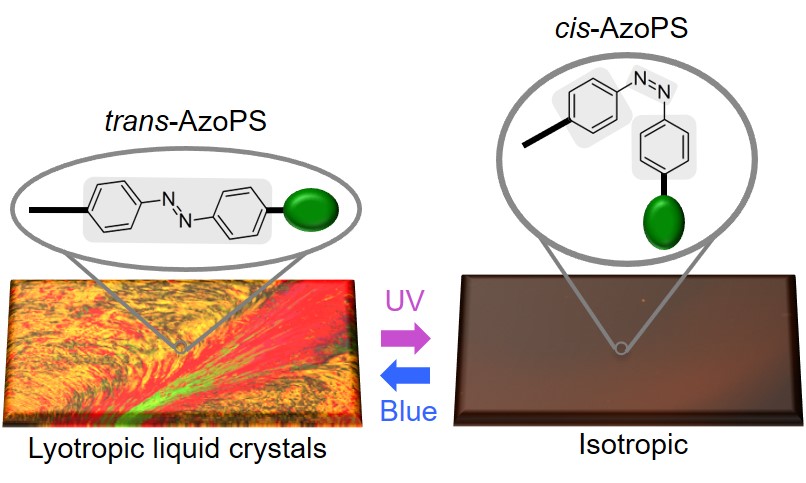
Congratulations to current and former group members Elaine and Judith whose paper entitled “Multimodal control of liquid crystalline mesophases from surfactants with photoswitchable tails” has been accepted for publication in Journal of Materials Chemistry C.
This work reports a family of neutral azobenzene photosurfactants which, using small-angle X-ray scattering and polarised optical microscopy, are shown to form a variety of lyotropic liquid crystal mesophases depending on the surfactant structure and solution temperature and concentration. Photoisomerisation of the surfactant with UV light leads to the destruction of the liquid crystalline phase. This process is reversible, allowing the liquid crystalline phases to be selectively created and destroyed on-demand.
Thanks to Diamond Light Source for time on Beamline B21 to perform small-angle X-ray scattering experiments.
Multimodal control of liquid crystalline mesophases from surfactants with photoswitchable tails, J. E. Houston, E. A. Kelly, Margarita Kruteva, Kiriaki Chrissopoulou, Nathan Cowieson, R. C. Evans*, J. Mater. Chem. C, 2019, DOI: 10.1039/C9TC04079J
Rachel Evans at MAF2019 & ACS San Diego
Rachel gives invited talk on the group’s work on Luminescent Solar Devices at the MAF2019 conference in La Jolla, California.
She also will give two contributed talks on stimuli-responsive fluids and aggregation-induced emission LSCs at the ACS Fall meeting in San Diego, California
Welcome Mike Bennison!
We are delighted to welcome Dr Michael Bennison to the group.
Mike, whose background is in both synthetic and polymer chemistry, will be working with the team on the SPECTRACON project funded by the ERC, looking at ways to develop new spectral conversion materials based on organic-inorganic hybrid polymers.
 Photoactive Materials Group