New article accepted in Soft Matter

Congratulations to former and current group members Camille, Judith and Elaine for their paper “Light-Responsive Self-Assembly of a Cationic Azobenzene Surfactant at High Concentration” which has just been accepted by Soft Matter.

They report the high-concentration and lyotropic liquid crystalline behaviour of trimethylammonium bromide azobenzene photosurfactants for the first time. These surfactants are often used in a variety of applications (DNA compaction, photofoaming, microfluidics) and have been studied at low concentration, but reports of their formation of lyotropic liquid crystals remain rare.

Using polarised optical microscopy and small-angle X-ray scattering, self-assembled structures with long-range order and optical anisotropy are found for the trans-isomer. These structures are lost or disrupted with UV light irradiation and photoisomerisation to the cis-isomer.

The work was carried out using X-ray beamtime at Diamond Light Source.

Congratulations to Kieran!

Congratulations to Kieran Richards, a second year PhD student in the group who won a prize for his talk at the UK Colloids 2020 Online Flash Presentations meeting on 20th July. Kieran presented his brand new work on the use of computer vision to analyse Pickering emulsions that he has developed during lockdown!

Advance Article in Nanoscale

Congratulations to ex-group members Barry McKenna and Abhinav Shivkumar, and current group member Bethan Charles for their new paper, which has just been published in Nanoscale.

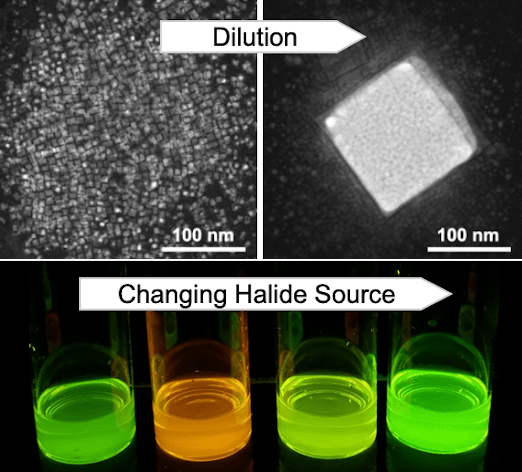
The stability and reproducibility of perovskite nanocrystals (PNC) produced by ligand-assisted reprecipitation (LARP) is investigated. Significant differences in optical properties and morphology are observed depending on specific synthetic factors. These differences can have profound effects on the resulting emission and stability of PNCs, although this is rarely reported in the literature. However, this information is important for new researchers entering a competitive field as well as in the drive to develop realistic pathways to scale-up synthesis. Therefore, we systematically examine (1) the effect of dilution of the parent dispersion, (2) choice of the halide source and ratio and (3) choice of capping ligand concentration in PNC synthesis.

Synthetic Factors affecting the Stability of Methylammonium Lead Halide
Perovskite Nanocrystals, Barry McKenna, Abhinav Shivkumar, Bethan Charles and Rachel C. Evans*, Nanoscale, 2020, Advance Article.

Paper published in SPIE 2020

Congratulations to Abi Collins, Thomas Southern, Morton Lyu and Mike Bennison whose SPIE Proceedings manuscript entitled Photoactive organic-inorganic hybrid polymer waveguides for optical device technologies from the Photosensitive Materials and their Applications Conference has been published.

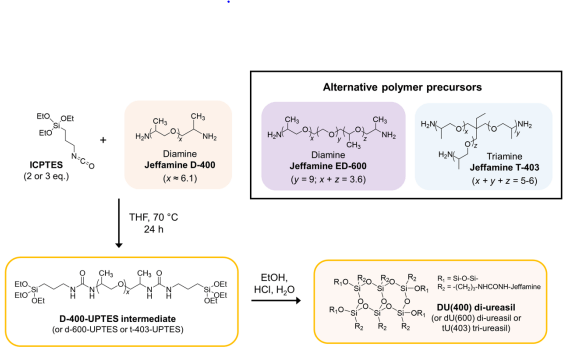
This work reports on the mechanical and optical properties of low molecular weight ureasils and the relationship between the molecular weight of their precursors and these properties. An array of techniques including steady-state photoluminescence and Fourier-transform infrared spectroscopy, 4-point flexural testing, and uniaxial tensile testing are used.

A relationship was observed between the flexural and elastic moduli of these ureasils and their molecular weight. The presence of unbound urea in samples was related to their water contact angle and stiffness. These relationships can be used to develop waveguide materials with tunable properties.

Abigail Collins, Thomas Southern, Guanpeng Lyu, Michael J. Bennison, Rachel C. Evans, Photoactive organic-inorganic hybrid polymer waveguides for optical device technologies. Invited paper, 11367-32, SPIE Photonics Europe Digital Forum, 2020.

New article in Cell Reports Physical Science

Congratulations to Morton Lyu for the co-authorship of a paper published recently in Cell Reports Physical Science. This work is a collaboration with Rute A. S. Ferreira’s group in Portugal.

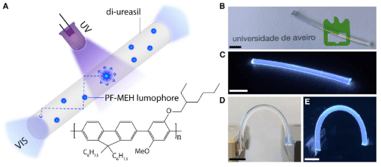
This work reports an advanced visible-light communication (VLC) system integrating an optical amplifier, made of a flexible fibre based on a poly(fluorene)-based lumophore doped within a di-ureasil organic-inorganic hybrid. VLC based on white light-emitting diodes has recently attracted much attention to provide high-bitrate data communication in indoor environments. One of the remaining challenges to be resolved to enable the proliferation of VLC systems is related to channel attenuation and multiple path fading. Our system offers a promising solution to overcome channel impairments, providing high bitrate coverage. Optical amplification is demonstrated for pre-amplifier and relay node scenarios, yielding a maximum gain of 5.9 G 0.2 dB and 3.7 G 0.2 dB, respectively, establishing the proposed approach as a promising cost-effective solution for VLCs. Additionally, numerical simulations show, for a realistic environment, a 207% improvement in the coverage area, using existing lighting infrastructure without extra cost.

Bastos, A.R., Lyu, G., Silvério, T., André, P.S., Evans, R.C., Ferreira, R.A.S.  Flexible Blue-Light Fiber Amplifiers to Improve Signal Coverage in Advanced Lighting Communication Systems. Bastos, A.R., Lyu, G., Silvério, T., André, P.S., Evans, R.C., Ferreira, R.A.S.  Flexible Blue-Light Fiber Amplifiers to Improve Signal Coverage in Advanced Lighting Communication Systems. Cell Rep. Phys. Sci. (2020), 1 (4), 100041. https://doi.org/10.1016/j.xcrp.2020.100041

New paper in Journal of Materials Chemistry B

Congratulations to former group members Ilaria Meazzini, Steve Comby and Judith Houston as well as current member Kieran Richards and visiting student François-Xavier Turquet for their work on the paper entitled “Synthesis and characterisation of biocompatible organic-inorganic core-shell nanocomposite particles based on ureasils” which has just been published in Journal of Materials Chemistry B.

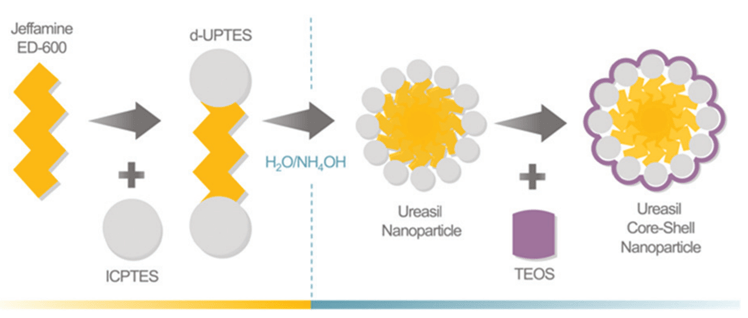
The paper reports a one-pot method for the fabrication of core-shell nanocomposite particles (CSNPs) comprising a ureasil core and a silica shell. The synthetic conditions are optimised to reproducibly form particles with a hydrodynamic diameter of ~150nm and a polydispersity of <0.2 which are stable in aqueous media for >50 days. Functionalisation of the particles via entrapment and covalent grafting is investigated using fluorescent dyes, providing insight into the internal environment of the particles.

Preliminary live/dead cell assays were also carried out, which indicate that the CSNPs do not show cytotoxicity. A huge thank you to collaborators Aimee M. Withers and Róisín M. Owens from the Department of Chemical Engineering and Biotechnology, Cambridge, for their help in obtaining these measurements.

Synthesis and characterisation of biocompatible organic–inorganic core–shell nanocomposite particles based on ureasils, I. Meazzini, S. Comby, K. D. Richards, A. M. Withers, F.-X. Turquet, J. E. Houston, R. M. Owens and R. C. Evans*, J. Mater. Chem. B.,2020, DOI:10.1039/D0TB00100G.

New Hot article in Nanoscale

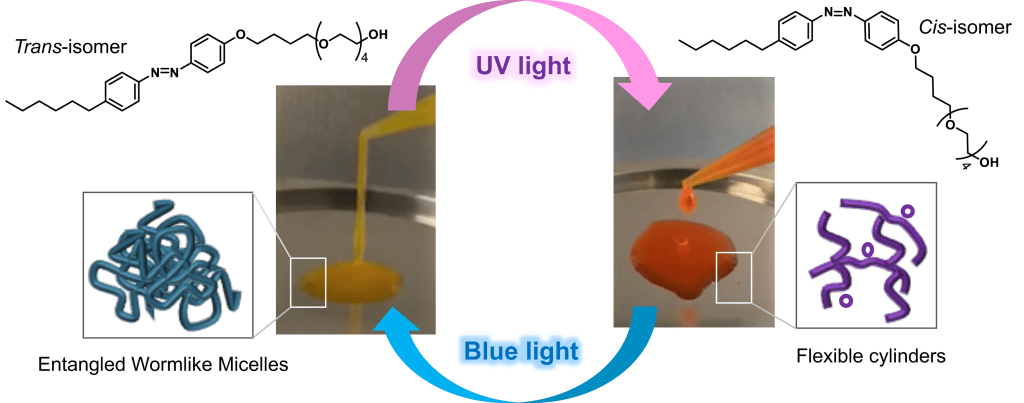
Congratulations to current and former group members Elaine Kelly, Judith Houston and Camille Blayo whose paper entitled A Single-Component Photorheological Fluid with Light-Responsive Viscosity has been published as a Hot Article in Nanoscale.

This paper reports an azobenzene photosurfactant, which at low concentrations in water, can reversibly switch between a high-viscosity, viscoelastic fluid and a watery, low-viscosity fluid, depending on the light irradiation conditions.

The work was carried out in collaboration with Nathan Cowieson at Diamond Light Source, Niamh Willis-Fox (also ex-group member) and Ronan Daly in the Institute for Manufacturing and Giorgio Divitini from the Electron Microscopy group in the department. Congratulations all!

A Single-Component Photorheological Fluid with Light-Responsive Viscosity, Elaine A. Kelly, Niamh Willis-Fox, Judith E. Houston, Camille Blayo, Giorgio Divitini, Nathan Cowieson, Ronan Daly and Rachel C. Evans, Nanoscale, 2020, 12, 6300 – 6306.