Materials Chemistry 14, Birmingham, 8-11th July 2019

Members of the group travelled to Birmingham to present their work at
Materials Chemistry 14, organised by the RSC.

Rachel gave a keynote talk on the Bottom-Up Design of Integrated
Spectral Conversion Materials for Luminescent Solar Devices. Morton also
presented a poster on this subject. Tom Parton, Elaine and Kieran
presented posters on photoresponsive materials, and Tom Southern
presented a poster on hierarchically porous membranes.

MC14

UK-IT Photochemistry Meeting, Lipari (Italy), 24-26th June 2019

Rachel was Co-Chair (with Prof. Alberto Credi) of the inaugural UK-Italy Photochemistry meeting jointly hosted by the RSC Photophysics & Photochemistry Group (PPG) and the Gruppo Italiano di Fotochimica (GIF) (http://www.fotochimica.org). The meeting took place on the beautiful islands of Lipari, one of the Aeolian islands, and attracted over 80 participants. Rachel attended the meeting, along with other members of the PPG committee, and Morton Lyu presented his work on luminescent solar concentrators as a poster.

The RSC & GIF are extremely grateful to the local organising committee, particularly Prof. Fausto Puntiero, who organised a fantastic meeting and have set the bar extremely high for the reciprocal meeting in 2021!

Lipari

(L-R) Rachel Evans (Chair, PPG), Bob Edkins (Secretary, PPG), Paul Scattergood (PPG committee), Olof Johansson (Treasurer, PPG), Victoria Porley (PhD student, Edinburgh), Colin Martin (Researcher, Nara)

Congratulations to Tom Parton – another image prize to add to the collection!

Tom Parton has one first prize in the Science in Innovation Unit (SIU) art in Science Oxford photo competition. Well done Tom!
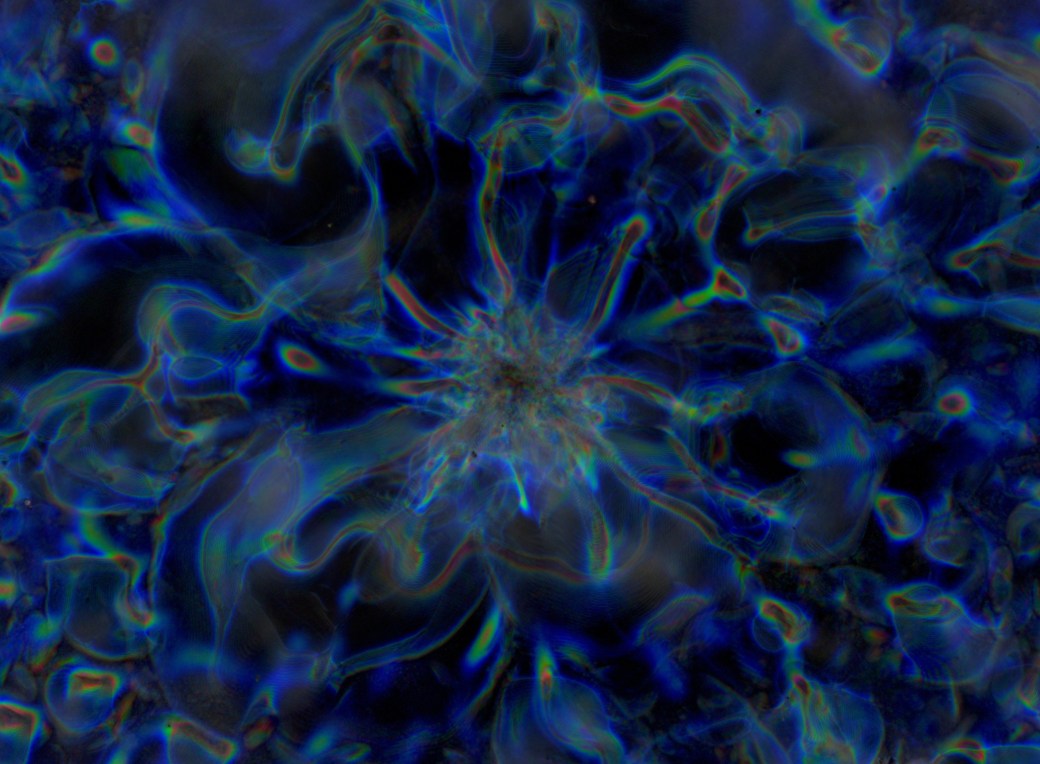
WORMKING_stitchcrop

Legend: The intense colours seen in this micrograph are created by cellulose nanocrystals, tiny slivers of carbohydrate extracted from cotton. Each individual nanocrystal is only 200 nanometres long; too small to be seen by eye, even under an optical microscope. However, under the right conditions these nanocrystals pack together into micron-scale screw-shaped structures which only reflect certain colours – in scientific terms, the colour reflected has a wavelength corresponding to the pitch (periodicity) of the screw. The image was taken on an inverted optical microscope in reflection mode with crossed polarisers.

Tom: In my research I study ways to use cellulose as a more sustainable source of colorants, instead of the dyes and plastics we currently use. The “tendrils” seen in the image are created when the cellulose crystals try to assemble around micelles (clusters of molecules called surfactants, which are the main component of soaps and detergents). I’m using these surfactants to move the cellulose crystals around and control their colour. This image is something of a failure, in scientific terms – I didn’t achieve very uniform colour – but I think it looks very beautiful nonetheless!