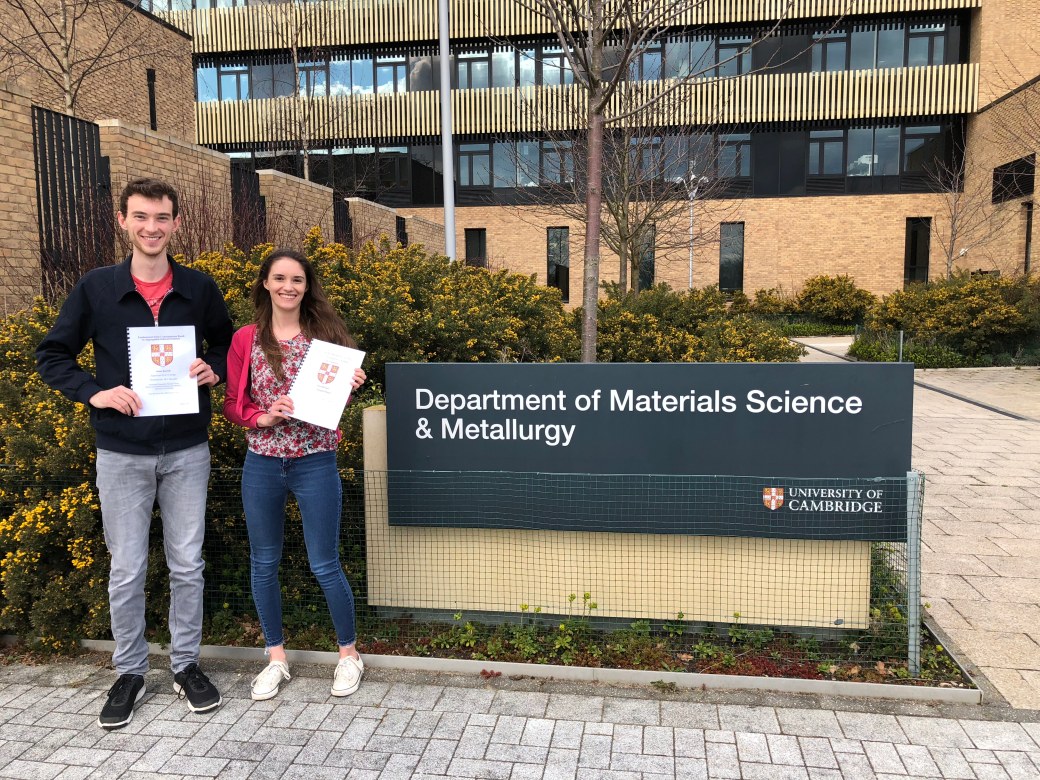
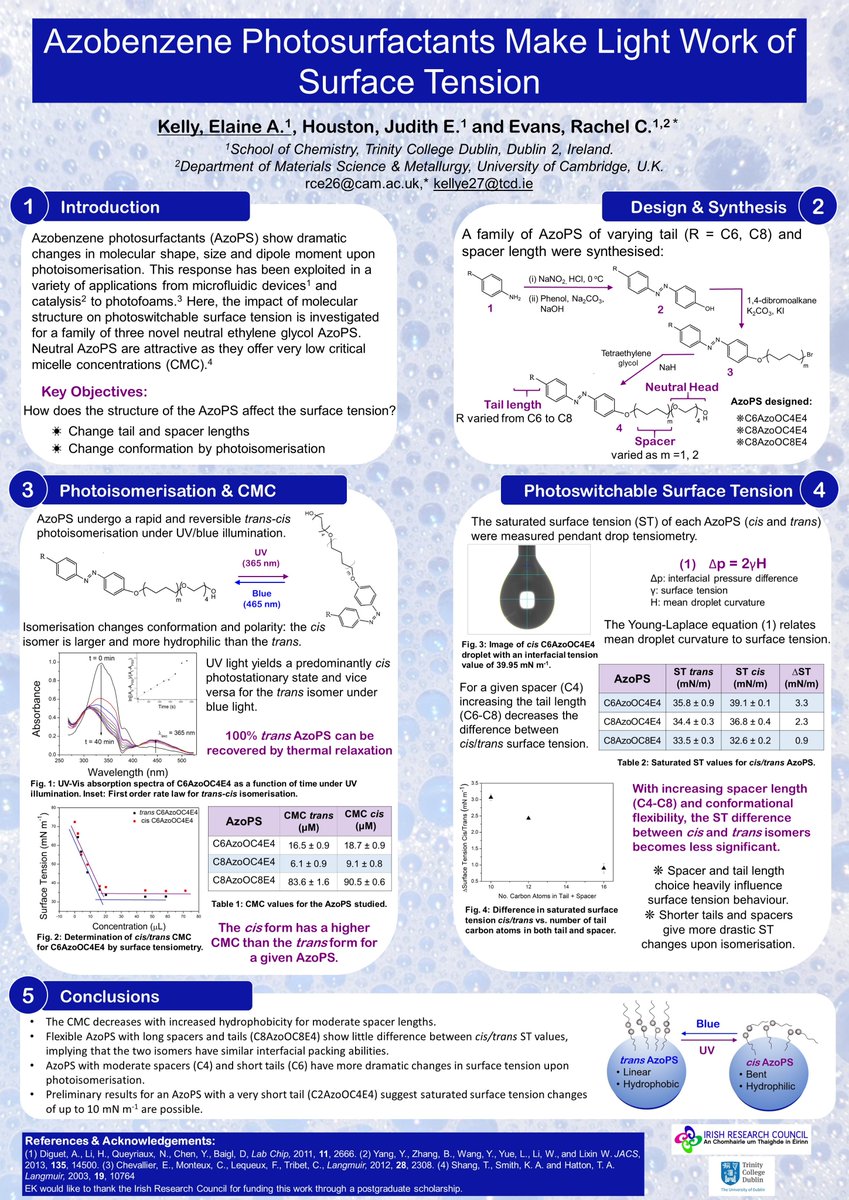
Dr Rachel Evans has been awarded the 2017 Young Researcher’s Medal by the RSC/SCI Macro Group UK for her research structure-property relationships in photoactive soft materials for energy harvesting. Rachel will be presented with the medal later on the the year at the Macro Group annual meeting. Thank you to all group members for their hard work.
Uncategorized
Group Update
This year has been one of immense change for the Evans Group, which has seen Rachel and the group split between two universities (and two countries!) for much of it.
The 1st of October 2017 marked the formal start of the new research group in Cambridge and we have had an exciting (and busy!) time setting up our new lab and welcoming new members to the group.
There have been lots of good things happening but very little time to keep this website up to date, but hopefully this is starting to change, so keep coming back to see what we are up to.
In the meantime, a very belated welcome to the new members of the group:
Ilaria Meazzini submitted her PhD thesis in Dublin and moved to Cambridge to help us set up the lab – lifesaver!
Tom Southern and Morton Lyu joined as new PhD students.
Amelia Mitchell, James Kendall and Joanne Pham have joined the group for their MSci (Part III) projects.
Tom Parton has joined the group for his first mini-project as part of the NanoDTC (co-supervised by Prof. Jeremy Baumberg, Physics).
Welcome all!
Dillwyn prize for outstanding ECR researcher in STEMM
Dr Rachel Evans has been awarded the Dillwyn medal by the Learned Society of Wales, which recognises outstanding early career research in science, technology, engineering, mathematics and medicine (STEMM). The medal was awarded by the President of the LSW, Sir Emyr Jones Parry, at a ceremony in at the Royal Welsh College of Music and Drama in Cardiff.

The Dillwyn Medals
Sponsored by Airbus Corporate Technical Office, the Dillwyn medals are named after the prodigious Swansea-based Dillwyn family, whose pioneering exploits in Welsh science, culture, politics and industry during the nineteenth century continues to serve as an impressive and inspiring legacy for young researchers.
Dr Judith Houston graduates – PhD no.3
Past and present members of the group joined together to congratulate Dr Judith Houston as she became the 3rd PhD student to graduate from the group. Judith has now moved to the Jülich Centrefor Neutron Science (JCNS) at Heinz Maier-Leibnitz Zentrum (MLZ) in Garching, Germany to take up a new position as an Instrument scientist on their small-angle neutron scattering beam line. We wish Jude all the best for the future.

L-R: Dr Adam Patterson (PhD no. 1), Dr Niamh Willis-Fox (PhD no. 2), Dr Rachel Evans, Dr Judith Houston (PhD no. 3), Ilaria Meazzini, Elaine Kelly, Barry McKenna and Camille Blayo. Poor Steve had to go back to the lab…..
Isaac Newton Trust grant awarded
Rachel has been awarded an Isaac Newton Trust grant for new lecturers at Cambridge. There will be a 6 month postdoctoral position available in the sol-gel synthesis of templated nanoparticles – watch this space!
EPSRC Studentship in Materials Chemistry
Hierarchically Structured Membranes for Environmental Remediation and Catalysis
Full or fees-only awards available to students who pay ‘home rate’ fees
Starting date: October 2017
Please contact Rachel for more information or click here for the job posting.
Porous membranes perform essential functions in a variety of environmental and energy related applications, including mass and gas separation, particulate filtration, water purification, and catalysis. However, the development of membrane technologies requires that the complex relationship between the chemical activity of the membrane material and physical parameters, such as surface area, pore size, connectivity, and morphology, can be both controlled and understood.
The aim of this PhD project is to develop novel organic-inorganic polymer membranes, that exhibit hierarchical porosity across multiple length scales, which leads to their superior performance in the destruction or capture of pollutants. To achieve this, a bottom-up synthetic approach utilising light-responsive templates will be used to adjust size, surface area and connectivity of the membrane pores. This will enable the relationship between the membrane structure and the flow and entrapment of pollutant species within the porous network to be studied directly. The long-term vision is to integrate these materials with fluidic device technology to realise advanced purification systems with in-built capability for remote and automated control. This project will involve synthetic materials chemistry, characterisation (X-ray diffraction, scanning electron microscopy, adsorption isotherms, small-angle X-ray/neutron scattering) and membrane fabrication and testing.
Elaine Kelly joins the group as an IRC postgraduate student
We welcome Elaine Kelly back to the group to undertake her PhD studies on hierarchically structured porous nanoparticles from stimuli-responsive templates. Elaine undertook her final year project in the group and was awarded a highly competitive IRC postgraduate studentship to return to pursue her PhD studies with us. Congratulations Elaine!
Barry McKenna awarded Junior Freshman Demonstrator Prize
Congratulations to Barry who was awarded the 2015-2016 prize for best demonstrator in the JF Physical Chemistry laboratories. The prize winner is jointly chosen by the undergraduate students and the academic staff members responsible for the lab. Well done Barry!

Applied Photochemistry Textbook
Photochemistry has existed as a branch of the chemical sciences for over two hundred years. However, the applications of photochemistry are very much a hot topic in modern day research, engaging scientists across a variety of disciplines. Applied Photochemistry, published by Springer in 2013, is a new textbook aimed at students and researchers in science, engineering and medicine who are interested in applying photochemistry in a broad spectrum of areas. Edited by Dr Rachel C. Evans (Trinity College Dublin), Dr Peter Douglas (Swansea University) and Prof. Hugh D. Burrows (Universidade de Coimbra), Applied Photochemistry brings together contributions from specialists in a variety of fields including solar energy, photomedicine, optical sensing, photochemical synthesis, electronics and imaging.

Editors: Rachel C. Evans, Peter Douglas, Hugh D. Burrows